Above image from http://www.cba.uri.edu/Scholl/Notes/Motivation_Expectancy.html
Project Management
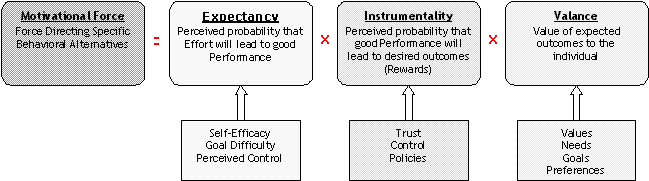
Expectancy is the simple theory of having people behave in the manner you expect them to behave. People basically work and perform functions to receive some sort of positive outcome. They will do good work because they see some type of reward occuring as a direct outcome of their actions. It also says if you create and expectancy in a person that expectancy may become fact. (Newell, p. 115)
Above image from http://www.cba.uri.edu/Scholl/Notes/Motivation_Expectancy.html
Motivate people to do something by showing them something desirable as an outcome, indicating how straightforward it is to get that outcome, and then supporting their belief that they can get there.
According to Richard W. Scholl, motivation is defined as the force that:
- Energizes Behavior- What initiates a behavior, behavioral patterns, or changes in behavior? What determines the level of effort and how hard a person works? This aspect of motivation deals with the question of "What motivates people?"
- Directs Behavior- What determines which behaviors an individual chooses? This aspect of motivation deals with the question of choice and conflict among competing behavioral alternatives.
- Sustains Behavior- What determines and individuals level of persistence with respect to behavioral patterns? This aspect of motivation deals with how behavior is sustained and stopped.
Douglas McGregor - "The Human Side of Enterprise" (1960)
Theory X and Theory Y
Look at http://en.wikipedia.org/wiki/Theory_X#Theory_Y
Theory X Assumptions
The average human being has an inherent dislike of work and will avoid it if he can.
* Because of their dislike for work, most people must be controlled and threatened before they will work hard enough.
* The average human prefers to be directed, dislikes responsibility, is unambiguous, and desires security above everything.
* These assumptions lie behind most organizational principles today, and give rise both to "tough" management with punishments and tight controls, and "soft" management which aims at harmony at work.
* Both these are "wrong" because man needs more than financial rewards at work, he also needs some deeper higher order motivation - the opportunity to fulfill himself.
* Theory X managers do not give their staff this opportunity so that the employees behave in the expected fashion.Theory Y Assumptions
Assumes employees are ambitious, self-motivated, anxious to accept greater responsibility, and exercise self-control and self-directio
* The expenditure of physical and mental effort in work is as natural as play or rest.
* Control and punishment are not the only ways to make people work, man will direct himself if he is committed to the aims of the organization.
* If a job is satisfying, then the result will be commitment to the organization.
* The average man learns, under proper conditions, not only to accept but to seek responsibility.
* Imagination, creativity, and ingenuity can be used to solve work problems by a large number of employees.
* Under the conditions of modern industrial life, the intellectual potentialities of the average man are only partially utilized.
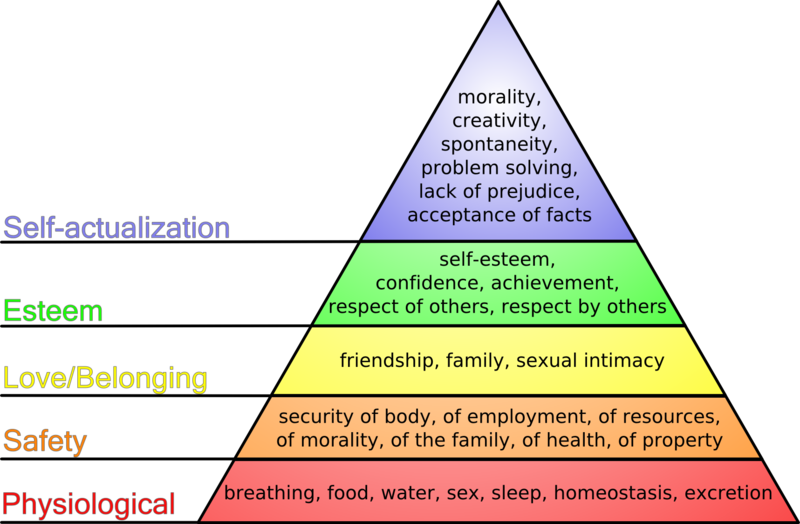
A Theory of Human Motivation
by Abraham Maslow (1943)
Look at http://en.wikipedia.org/wiki/Maslow%27s_hierarchy_of_needs